Search This Blog

Friday, March 29, 2013

My Troubles With The Bitz

I recently switched up my fletching jig from a relatively non-adjustable inexpensive model and picked up a used Bitzenburger jig. This jig is very adjustable and the “gold standard” in fletching jigs. I figured it would only help my arrow making prowess. I set up the jig with a left helical clamp and went to work trying to adjust the clamp properly on my test shaft. It seemed to align perfectly. Then I started fletching my first dozen arrows and began to have problems. It seemed that when I rotated the receiver to put on feather #2 and #3 they did not make contact from leading edge to back. I ended up with a few that had gaps in the glue line. After some time I finally figured out the problem. The newer mercury speed nocks and bohning classic nocks I had been using have a fairly high indexer on them. When I first aligned the jig I made my adjustments based on the cock feather position. The indexer on the nock was making contact with the nock receiver and preventing it from being perfectly centered. Once I rotated the receiver the misalignment was magnified. I ended up taking my broadhead file to the indexer for a few swipes and my problems were solved! The picture below has a vintage Bear archery POC nock, along with my modified nock, and the original unaltered nock. Another lesson learned…. Once again I find that sometimes our “improvements” in design as not always the “best”.

Friday, March 22, 2013

A Day in the Woods

I got to take a day off from Daddy duty yesterday and spend the day in the woods. Call it a kind of mental sanity day. With Mom and Jr. off to work and daycare, I was able to finish spray capping a dozen arrow shafts while I waited for Mike to arrive. Shortly, we headed out to public land to look for sheds, scout turkey, and shoot at targets of opportunity (roving/stumping) with the longbows. I think we covered a majority of the land and got to exercise our lungs on some of the steeper elevations above the river. We walked from 9am until 1:45pm. Who knows how many miles we covered once we decided to break for lunch. After lunch we headed back to my mountain home and took a few more hours of walking up that slope. We did manage to find one shed that had already started sun fading, probably dropped early this year. Luckily the squirrels and rodents had not chewed it yet. That evening we were both pooped and reveled in a successful day. My shooting could have been better, but I'll work on it. I broke about 7 of the cedar arrows I carried in, but none of the 3 douglas firs. That really shows the toughness of the two shafts in comparison. Mike's new bow was working well for him!

Thursday, March 14, 2013

All In The Family

My first bow when I was a small boy was a flimsy fiberglass stick with a twine string that fired wooden suction cup-tipped arrows. I can remember as I got older I pulled off the suction cup and sharpened the shaft in a pencil sharpener. I soon moved up to green and red fiberglass “flight bows” sold by Sears and Montgomery Ward. My nephew still has my first real hunting bow. It was an Indian archery duel shelf plastic-tipped green fiberglass bow of 45 pound weight. I took to the fields in chase of my nemesis the ground hog. My father was born in 1929 and he became a bowhunter presumably after the struggles of the depression allowed “frivolous pursuits” in game. His father was a big water fowler on the Susquehanna River, but doubt he did much bow hunting. My father’s bow was a tan solid fiberglass Ben Pearson takedown longbow of 60 pound pull. I can remember this bow as it was retired having had the lower limb tip ground off from years of abuse. He then purchased s Bear Whitetail compound bow and I have found memories of shooting with him in the front yard of our home. He shot with a calf hair tab and I could not get over the speed of his aluminum arrows compared to mine. My brother started killing deer with a Jennings Sidekick 3 after a few years of hunting with Dad’s Ben Pearson. I bet he was the reason for the ground off tip. He was ten years older than me. I do know he helped pick out my first compound bow in the winter of 1987. It was a browning Deluxe Nomad II wood risered beauty. I remember him telling me he was so impressed it was super light at 3 pounds compared to his all metal arrow slinger. I shot this bow with a glove and no sights and had 4 fletched 2219 aluminum shafts tipped with 4 blade Satellite broadheads. It took me many years to collect my first yearling doe and that was after missing it with the first shot from an old wooden platform nailed to a locust tree. Truly culling out the dumb ones on that hunt, but you never forget the first….especially when it was such a long hard road. My brother again was responsible for introducing me back into traditional archery after years of shooting modern compounds and releases and all the crutches and gadgets that came with it. He gave me his fist longbow after buying a custom Rio Bravo Long curve. The bow he gifted was a 60 pound @ 28 inch Earl Hoyt Jr. Sky Archery Trophy Longbow. I skeptically brought this bow on a late season January 2006 hunt. I was sitting on a chestnut oak stump as darkness started to settle when a conga line of over 15 deer soon engulfed my position. I had deer all around and one pesky fawn within 8 yards of me behind a mountain laurel bush threatened to blow the whole deal. That’s when I finally got an opportunity to loose an arrow at a mature doe as she stepped out from behind the Y of a branched trunk. I heard a solid thunk and saw her blow out with tail down! I was certain I hit her well and was as excited as I had ever been….that is until I realized my arrow with bear razorhead was embedded in the Y trunk of that tree. But I was hooked! The following September found me with longbow in hand and I have never hunted with the compound since. I hunted again from the ground on a stool when one sultry September afternoon another young button buck stepped right toward me and gave me an 8 yard shot. The shot selection was poor as he was quartering toward me. I sat there brimming with adrenaline and at the same time frustration at such a dumb shot. Then it started to sprinkle rain. Great…. Suddenly I saw an adult doe break the tree line of the firebreak I was just inside of and come jaunting by. I drew back on her with no intention of shooting. I held and held….and she was still closing in and coming broadside at 12 yards. I couldn’t take it anymore and loosed. The woodsman tipped arrow blew through her ribcage and she exploded down the hill followed by the sounds of thrashing and crashing….then silence. I found her easily enough and called my pal Brent to help me track the small one. We did not find him as rain started to come down heavy. We decided to butcher the deer we had in hand and I would go back the following morning before the heat of the day spoiled any meat. The temps were up around 60 degrees that night and I was doubtful, but I found him about 80 yards from the shot site and only the loins were spoiled from contact with gut contents. I was lucky and learned a great deal on that hunt. This was my first, “real first”, deer. I can see those events like they just happened yesterday. My brother made me promise to never sell that Hoyt bow. This year he has another in-law that wanted to switch from compound to trad, so I kindly repaid the offer and gave him the bow that started it all for me…again. That is the beauty of life and hunting…we continue to learn and start over. Each time we do and it makes things harder and then the resulting success ends up being that much more memorable. That is what it is all about. Late December my wife gave birth to our son Garrett. He will have his own path to follow in life, but I will be sure to help him along with as much of my values, ethics, and family traditions that he will accept.

Friday, March 1, 2013

A Traditional Shave

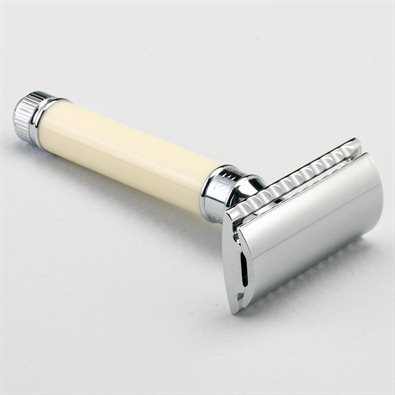
The more I learn about "The old days" the more knowledge I find forgotten. I have been long using the old style shave soap and brush/mug technique to lather up my whiskers. I found the "modern" aerosol can and costly shave cream to be wasteful and a poor value. The solid shave soap lasts a long time and the works pretty darn well. However I was still using my old plastic disposable razors. Something just did not feel right about the chinsy plastic "tool", so I began to look elsewhere. I was enthralled with using the old straight razor method my old barber used to employ (I have been cutting my own hair now for several decades), but fearful of cutting open an artery in a groggy state of confusion some early morning. I wanted to try the old style "safety razor". These little beauties have been around for a long time and I found a new version of that style at the Duluth Trading Co. I received the razor and immediately felt that this tool was substantial. No flimsy piece of junk here. The all metal head was solid and the handle was short but well balanced. The look was classy and antique. Then I tried her out. All I can say is WOW! A benefit of this style is that the hot water makes the metal head very warm to the touch and that soothes the skin as you shave. It felt marvelous! I was also skeptical that the single flexible blade would be better than the triple-bladed over-engineered plastic wonder I had been using. My fears were unfounded. This razor gives a very close and comfortable shave. I am now looking at flea markets and stores for a deal on a vintage razor kit so I can save this one for travel (in my classy leather travel case by the way). Anyway, I am glad I gave this a try and I doubt I will ever go back to the plastic shavers again. Until next time..... "Happy Hunting"

Thursday, February 14, 2013

Crafting Wood Arrows

After the last day of deer season there is time for equipment maintenance and re-tooling for the following season. Nothing builds anticipation for the hunt more than crafting and customizing your own equipment. There is little disagreement with the experts that the arrow is the most important component of an accurate bow shot. You can shoot a twig with twine and be accurate with a well matched straight arrow....but try to shoot a bent knarly, too weak, twig from the most expensive black widow recurve and you will be lucky to hit the backstop at 10 paces. When I shoot my Straight end longbows it just seems wrong to shoot anything but wood out of them. Yes, carbon and aluminum are much straighter and more consistent, but it just seems wrong. Plus I can put more personal touches and do more myself with a wood shaft. I have made shafts out of red oak, maple, birch, and will someday use poplar I have drying, but when time is limited I like to buy raw wood shafts and start from there.Photobucket Photobucket Port Orford Cedar has been a favorite for generations, but the existing old growth cedar has been depleted to the point that getting good, straight, wide growth rings is becoming near impossible. I have found that for my hunting purposes I like a little more durable and heavy shaft than POC. I hate straightening shafts. I found the perfect solution for me right now...Douglas Fir. These shafts are straight and from older growth wood. They are durable as all get out and need very little straightening and "maintenance". I prefer to get my shafts from the supplier to save some money. There is a small company called Surewood shafts (surewoodshafts.com) that knows their stuff and makes a quality product. In addition, their customer service is hard to beat. I highly, highly recommend them! I stick with the premium shafts because I hate to straighten and as I said, the arrow is all important. Photobucket I have recently found a love for tapered wood shafts. I learned that my old tapered carbon shafts were very spine tolerant and seemed to be easier to tune and fly better, so I thought I would give tapered woods a try. I decided to build my own inexpensive tapering jig by using some angle iron I found as scrap and some 1 inch wide sanding belts. Chuck the shaft up in a drill and viola! After a few minutes an nice taper from 11/32 to 5/16th at the nock end. Next, I will sand the shafts with fine grit sandpaper to get rid of the sanding marks, then use 0000 steel wool till they are smooth. Then, I straighten them with a little help with the ace roller on a piece of glass until I am happy. Then they get a coat of minwax poly in clear gloss. This seals the shaft. Then, I steel wool it again a bit, and either paint, or put on more coats of poly if I am going "nude". Photobucket Usually, I will put on a cap of white krylon or rustoleum enamel followed by a second coat (after sanding) of the preferred color. The white really makes the color pop and you can tape off a nice spot for a crest on the white. I use a old cardboard box as a makeshift paint booth and do it outside or at the entrance to my garage using a N100 mask for protection. Here is my high tech crester (a cordless drill duct taped to a 2x4) and paint booth. Photobucket Photobucket After all your fancy work is done and the nock is glued in (I prefer duco cement for this), it is time for fletching. Photobucket There is just something classy about natural barred turkey feathers! In my opinion they are also the most durable fletch you can use. Most commercial barred feathers are white and dyed to look barred. I think something in the genetics and processing of these domestic turkeys produce a feather that is not as stiff or durable as their wild counterparts. Nothing beats real turkey. Tell all your hunting friends to save you the wings from their successful hunts. If I had to rely on my turkey hunting success with the bow I would have zero feathers to work with. This will be my 7th year chasing them with traditional tackle and I have yet to launch an arrow at one. Once you have the feathers you can turn them into commercial looking feathers with the aid of a belt sander and a sanding jig (mine is made from an old broken metal ruler and some binder clips). A chopper or burner (I use a chopper) is used once the quill is ground down to the proper level. I use an inexpensive Jo-Jan jig and have settled on loctite superglue to affix the fletchings. I find this to be the most compatible with my sealers, it sets up nice and quick, and is really durable. I tried and tried fletch tape, but I do not find it to be as durable as good old fashioned glue. Photobucket Photobucket This is a repair job on an older arrow: Photobucket You can get pretty fancy. Here is an all white shaft that reminds me of something Howard Hill would have had in his back quiver.Photobucket Have fun! Once you start building your own tackle you may find a whole new satisfaction to your hunting and shooting. Photobucket

Tuesday, January 29, 2013

Knives Of The Hunt

It seems like most older hunters have always had a fascination and infatuation with their knives. This probably was ingrained long ago in male DNA due to their integral part of everyday survival. Having a good hunting knife was the mark of an responsible adult in my circles growing up. Looking at the accouterments of "Otzi the Iceman" one can only marvel at the short stone blade he carried and relied upon. A few years ago my bowhunting comrade and I were scouting a ridge line here in Maryland when we came upon some stone outcroppings. Jokingly, I told Brent, "Keep an eye out for arrowheads" as we always look but find any except in the freshly plowed fields of my youth or out in western states. No sooner had I taken a few steps but Brent called out "Here's one"....Yeah right! I looked back as he plucked a white stone from the gravely rocks beneath this outcropping. Holey Moley! That is the real deal. Here is where it was found:
I had discovered a small shed antler roaming around a few months earlier and Brent donated the "point" to me. I decided to restore it to the form it was most likely used...a knife. I did some research and this type of point was used about 10,000 years ago here in MD. After all these years it was not "super sharp" anymore but could be made that way by someone skilled in knapping quartzite. I bet it could still be used to skin or scrape an animal in its present condition which now resides in my curio. Photobucket Growing up on a farm I received my first hunting knife at an early age probably in the mid 80's. I can remember it was a Christmas or birthday gift (mine were both close together) and I was thrilled. I carried it everywhere and used it for squirrel and rabbit until I was able to kill my first deer with a 12 Gauge and use it for field dressing chores. It was a knife I had seen on TV on the belts of the Dukes of Hazard....and every adult male I knew carried a similar belt mounted tool. It was the classic buck 110 folder.
Over the years I acquired other similar folders, namely the Schrade Old Timer. These knives proved work horses and have been used over and over again. Classics!
One day while rummaging through my fathers garage I came across an old "western style" knife with stacked leather handle, pitted, with a thin blade, and obviously well worn. My father said it was grandfathers knife. I immediately used it for hunting. I crafted a Fred Bear style knife sheath and archery kit out of an old pair of Concoran combat boots from my prior Army service. This knife has been with me for many years now on trips to New Mexico, Idaho, and Colorado chasing elk and mule deer. Field dressed dozens of deer, proving the quality and classic design of these belt knives. I finally retired this knife for another family heirloom I will describe in this article later. Photobucket Photobucket I just love going through my father's garage. He had manged to acquire what my mom would refer to as "junk" passed down to him through my many great uncle's estates. One such day I "found" two very interesting blades. One was another old Western style fixed blade. The stacked leather handle disks deteriorated and were discarded years ago. The blade showed thick pitting but I knew I could bring her back to life. My dad told me, "go ahead and keep them". I immediately set to work on his bandsaw and joiner to cut a couple pieces of osage orange scales from scrap I had there from a failed selfbow project. I had just met another local fellow bowhunter who had been stricken with the traditional archery bug and saw my Traditional Bowhunters of Maryland sticker on my truck at a landscaping store. We reconnected through Tradgang and were soon sharing time afield. I learned Mike had a passion for osage and decided to gift him the knife once it was complete. I settled on some bison accent strips from a powder horn project I had recently completed. I figured it would look sharp. The project came out beautiful and Mike was tickled when I suggested if he did not like it he could always use it for his first traditional deer and then retire it. Turns out he loved it and a osage MOAB was soon delivered which accented it nicely. 2013 will be the year to bloody this knife Mike! Photobucket Photobucket
The second knife I found in the "junk" drawer that day was this old heavy bladed knife that looked like a Puma to me. I thought it interesting and took it home to study. There was nothing I could read stamped on the blade. I managed to discern the stag handle was not imitation as I first suspected. The scale pins were large and crude looking. The blade was very thick at the handle. My dad told me he did not know where the knife had come from but he was sure it was from one of the great uncles and could have been in the family a "long time." I began to do some quick internet research and I was amazed that almost unanimously the consensus was that this knife was homemade, perhaps from a old file, but whomever had done the work did an excellent job and was very skilled. I was ecstatic I had something so unique from my family and had to take it hunting. I was able to break it in during the late fire arms season on a large doe taken with a "sporterized" GWER 8mm Mauser my dad handed down to me. It has been my main hunting knife and is now carried in my homemade Bear archery kit style sheath. It just has a mystique to it. Photobucket Photobucket Photobucket If the next knife could tell a story, it would be a whopper! My dad showed me this knife and I could tell he treated it with a little more care than the others from the "junk" drawer. The knife was slim and well worn from many sharpenings. It did not seem very remarkable to me with a non-existant gaurd and small rosewood scales. He told me the following anecdote, "This knife was one of the last things off a carrier in WWII before she went down". He said it was from "uncle George" (his). I knew great uncle George had been in the Navy but I had a hard time believing this knife with a plastic looking pommel could be from WWII. I started my research with the knife, it was marked "Ranger" and the rest was not readable. After some scouring of the internet I was able to find similar ones that had sold and the descriptions stated this knife was common among soldiers and that the pommel was indeed bakelite. The knife was indeed a WWII vintage boot knife. Next, I set about researching George's service. My mother was able to quickly produce some documents for me since she was embroiled in doing some family genealogy at the time. George was in fact the purser for the carrier Hornet. The Hornet was sunk at the Battle of Santa Cruz islands. Being the purser and responsible for safeguarding the ship's payroll safe, he may have likely been one of the last to leave the ship That day. He likely had this knife when the Hornet launched the "Doolittle raid", and after the sinking he was re-assigned to the USS Princeton for the remainder of the war in the Pacific. Now that is something else! My Great uncle George was likely on this carrier as this photo was taken during the Battle at Santa Cruz Islands.
Photobucket During my "militant" years I was given another gift by my brother Chris who was at the time my brigade S-2 in the same outfit. That gift was the Gerber Mark II Combat knife. This knife saw service in Vietnam and was a constant companion on both my LBE during duty, as well as my hunting pants while off. Not the fist choice for a skinning knife with its long slender blade but a useful tool nonetheless. I learned quickly it was a handy and easily accessible cutting tool, as well as something to lightly chop and poke the fire with. It kindled a niche for a very sturdy "side arm" knife that was a little bigger than the average hunting knife. Photobucket I slowly wanted a more "traditional" looking knife to serve my niche needs, and I picked up the venerable buck model 119. I carried it for a few seasons but found the handle slick when wet and blocky feeling. It was a quality tool however. Soon it found its way from my belt to my shop and was used as my primary scraper for making my first selfbow. Photobucket The next knife on my list was soon to become an all around favorite. It was a gift again from my brother and I soon repeated the gesture to my good friend Mike. The K-BAR needs no official introduction as its combat history and folklore are well known. I soon found out just how valuable this tool was in practicality. I carried this on my first elk hunt in Colorado and it became quickly apparent this single tool could take the place of many others I was imprudently packing up the big hill. This knife was in constant use and easily accessible on my belt. It was used to cut cord, prune shooting lanes as a small machete, to cook with and stir the cooking fire, as comfort protection from bear and lion if needed, as a hammer to pound in my tent pegs, and even as an hatchet or hawk to split kindling. This tough tool did it all! The following year I shaved off many unnecessary pounds by just relying on the good old K-BAR! You will find this tool on my belt whenever I am in the wilderness from now on. Photobucket Finally the last knife I "acquired" is the handy Shrew "Lil'Shaver". This knife in actuality belongs to my newborn son Garrett. A gift from my fellow brother of the bow Mike Mongelli. The sheath is signed by Ron LaClair and dated with my son's birthdate. A finer gesture I cannot fathom. The blade is perfect for use on whitetail as a field dresser and skinner. The quality is superb and I would highly recommend anyone who is in need of the perfect whitetail neck knife to check it out. I took the knife for a snowy cold test drive and snapped a few pictures, however I need to create a new sheath if I am to continue to use it until Garrett is old enough so I can preserve the signature.....but he already has his first knife. The tradition continues.... Photobucket Photobucket

Friday, January 25, 2013

The Deer Mock Me!

I came home from work last night and backed into my parking spot by the garage. On the hill beside me was a nice adult doe at 15 yards just browsing acorns from under the snow and leaves. I sat there idling the truck and watching her with the small binos I keep in the console. Then as she moved off I saw a small 6 point behind her….then a little bigger 8……then a really nice 8 point! I was astonished as yet a 4th really big buck, only sporting the left side, brought up the rear. I saw flashes behind me as Angela had seen them from inside the house and was now in the garage door taking photos. They all went by my back door and the doe actually drank from my birdbath. So many nice bucks at bow range this late in the season and me without my bow and sitting in my vehicle. Such is the way things work.