Search This Blog

Monday, August 28, 2023

Refurbishing Vintage Fiberglass Arrows

I recently helped an older gentleman liquidate his archery and bowhunting inventory.  In the collection were various early fiberglass arrows.  The nocks were brittle, the heads were rusty, the fletch was all but destroyed.  These arrows intrigued me because they felt pretty heavy.  A particular batch of 10 were woven brown glass shafts with the number "11" as the only marking.

I decided to try to put these back into service.


The project was such a success I decided to start on these #10 shafts also.


Here they are the #10s with the fletching removed and sanded lightly with 100 grit.


Here are both batches completed:

I read and actually heard from the gentleman himself that a common complaint was that the shaft would split upon hard impact.  Swinehart didn't care as he said he, "had a lifetime supply".  I decided to foot them with a inch length of aluminum arrow and epoxy that on for a stability collar.  

The project tuned out well but the spine was a little much for my current Northern Mist longbow.  So I will keep them for later.  I have plans to work into a higher draw weight bow in the future now that I have made my transition and have been shooting left handed for some time.


Friday, May 26, 2023

Squirrel Pot Pie Recipe - Tender and Delicious


Hunting squirrels is always a fun endeavor but some are reluctant to pursue the bushy tails with a passion because of their tough constancy.  I found a solution and a recipe that makes me want to load up the back quiver with all my cast away arrows and hit the woods.

When I grew up my mother would bar-boil the critter quarters for 20 minutes or so to tenderize before breading them with flour, salt and pepper, and baking in the oven.  They were good this way but still a chewy undertaking.

Lately I have been doing a lot of canning of my deer, chicken, and pheasant and I decided to can a bunch of squirrel quarters. The result after the pressure canning was fall off the bone tender meat.  

At a big camp out 3D bow shoot I was at I decided to make some pot pie and the results were so amazing I shared the meal with several camps that agreed it was goooood eating!

Canning the squirrel has many benefits including making it tender, giving you squirrel broth, leaving precious space in your freezer, and storage for years without freezer burn.

Here is how I made the meal.

First take the quart of squirrel pieces and pour off the squirrel broth into another container for later use. De-bone the meat taking care to leave no bones or fragments.  This is fairly easy as the meat is falling off the bones.  The hardest part is keeping the small vertebrate out from the back pieces. Set the meat aside as you prepare the rest.

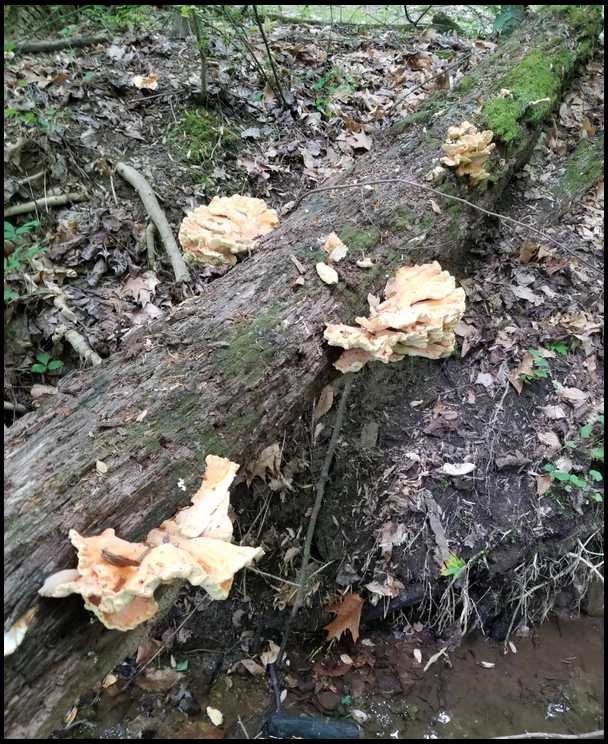
Next, heat up your cast iron dutch oven or large sided skillet with lid to medium heat.  While this is heating, slice and dice your onion and add it to the fry pan with 1 tablespoon of butter and saute until the onion is tender.  You can also add your veggies in at this point.  Out on the range I found this chicken of the woods mushroom growing, so I put a few tender pieces in my cargo pocket.  I sliced these thin and sauted them with the onions. 

Then, add the de-boned squirrel meat, salt and pepper, minced garlic (about 1 clove worth) and heat all for another 5 minutes or so stirring.  Since I had only one pan, I removed all this and set it aside, but if you have another pan melt the 1 tablespoon of butter and add the flour stirring constantly until you have a rue. Once a nice brown color is reached pour in the squirrel broth you saved, and while stirring smooth add the meat mixture in until it is nice and thick and bubbly. I also added a splash of home-made raspberry wine at this point.

Remove from heat.  In your clean dutch or lidded pan place the first pie crust and pour the entire mixture into the center of the pan.  Leaving a ring of exposed dough like this:

 Next put on your top crust and smash/pinch together the exposed ends with your fingers.

Now you have this:

I used charcoal briquettes in the fire pit and placed about 15 of them on the lid and a little more under the pan.  Rotating the pan and lid until I got a nice even brown.  Maybe about 15-20 minutes baking time.

It came out like this!


Wow, it was good!


I will be canning all my squirrels from now on.  Happy Hunting!


Ingredients:

1 quart jar of pressure canned squirrel quarters  

half an onion diced

veggies peas, carrots, celery or add ins (for this recipe I only used sliced thin chicken-of-the-woods mushrooms I found along one of the courses)

2 tablespoons butter

2 tablespoons flour

2 pie crusts

diced garlic about 1 clove worth

Salt and pepper to taste

Tuesday, January 31, 2023

The Value of Moving Target Practice

It was a blustery day in late November of 2014, and I was perched in the early morning hours atop my climbing stand.  I was tucked against a large trunked chestnut oak bordering a line of mountain laurels.  It was rifle season in Maryland, but I wanted to connect with the longbow. As stiffness and chills started to take over and the morning waned, I stood up and tried to stretch for the sunlight that was slowly warming the frosty leaf litter below.  Behind my stand I heard crunching, and turned to see a 6 point buck feeding along the line of shrubs.  I knew a shot behind my stand would be tough, but I felt it was doable.  I leaned out far and slightly canted the slender Schulz made Howard Hill Tembo completely vertical.  I had not practiced this cant much and pulled the shot due to alignment issues.  The arrow sailed and struck the unsuspecting buck in the hind bottom roast! Oh No!

I don't know why, maybe the quietness of the longbow combined with the impact point, but the buck turned and ran toward me.  I quickly drew another arrow from my back quiver and from so much ingrained practice, had the arrow pulling back to anchor as the deer ran 15 feet from my tree at a full tilt.  I focused hard behind the shoulder and the arrow was away.  It was a blur and my mind caught movement of the arrow, but it appeared to me that I had shot over the shoulder.  I drew another arrow and the buck stopped 87 yards away and I let fly again.  The buck bolted.

This scenario came to a happy ending for the hunter when we found my buck with my arrow in the chest.  As it turns out that running shot did connect.  A wounded deer that would otherwise have been suffering was killed cleanly.


Since then, I have made it a point to practice all manner of unorthodox shots as well as work on hitting moving targets.  The Hill style straight end longbow excels at being forgiving of these unorthodox shots.  

Some will say that gaining proficiency at these kinds of shots takes extra-ordinary talent, or that it is unethical to take these shots at game.  I can say that I have no great reservoir of archery talent, nor am I a one of a kind the likes of a Mr. Hill or Schulz, but I have gained a comfort in hitting moving targets that gets better with practice.  As evidenced by the scenario above, this skill is at times ethical and a benefit.  The last item is that this type of practice is darn fun!


There is no need for a complicated set-up or area to practice hitting'em moving.  Having a person throw for you is great, but not a necessity.  Simply tossing a tennis ball or kickball and using rubber blunts has worked well for me.  Having a slight hill also helps.  

Recently, I worked up a simple cable and pulley system for a cardboard disk that was fun.  This target was made by gluing simple cardboard circles together and zip tying it to a pulley from my porch railing to the ground below.


Practice focusing on the smallest part of the target as you can.  Keep that concentration as you relax your fingers.  

Practice always makes these types of shot easier.

I also practice some unorthodox techniques like the reverse cant, and turning behind shots.  

This type of practice is fun and can benefit you in hunting situations.  Don't let the "nay-sayers" stop you from trying.  This type of hunting practice used to be common, but now there is a definite static hunting trend.  Don't let them limit you.   

Take a look at Gene Wensel in these old videos of him and companions hitting big old bucks on the run.  It can be done, and done responsibly by getting proficient. 


You never know when this will pay off.


Enjoy!


Tuesday, January 24, 2023

Nate Steen of Sunset Hill Longbows Demonstrates using a Back Quiver Video

This is a very good informative video for anyone who wants to learn how to use and reap the benefits from using a back quiver in the Hill style for hunting.


Friday, January 13, 2023

Cooking, Preparing, and Eating Deer Ribs (Venison Ribs) with a Pressure Cooker (Insta-pot)

One of Fred Bear's "famous game recipes" as related by several publications from those like Glenn St. Charles and Bob Munger was flame broiled sheep ribs over an open campfire.

Here is a photo of Mr. Bear roasting some sheep ribs in 1954 from Bows on the little Delta: 


Ever since seeing those photos I have tried to cook deer ribs, but most attempts proved terrible as the white chalky fat leaves a paste and coating in your mouth well after the meal.  Deer fat is much different from sheep in taste.  I came across a tip from a fellow about boiling the ribs in coffee to render out the fat before roasting or BBQing.  I tried this and it actually worked well, though I blew through many pots of coffee. Later, I got the idea of using my pressure cooker and use only 16 ounces of coffee in the bottom instead.  This proved to be a super method I wish to share.  

I have also roasted them over a open fire successfully, but it takes diligent trimming and a slow roast to render out all the fat.


I typically use a cordless sawzall to cut away the ribs from the hanging deer.  I cut down parallel to the spine, then down removing them away from the sternum.  

Next I will wash off any bone chips or blood and try to remove any bulk fat that is easy to cut away. I also cut away and sections shot through.  These sit in my refrigerator most times for several days to age as I process the other part of the deer. 

Next, I cut the rib slabs big enough to fit in my pressure cooker.  Sometimes this takes some creative arranging and trimming to get them to fit. Then pour in 16 ounces of coffee to the bottom and set the cooker for meat/stew setting for 40 minutes. 

Once pressure is released I drain the ribs and coat with a dry rub / or some BBQ sauce before putting them in my smoker for several hours around 225 degrees. 

At the end they are delicious!


Tuesday, November 15, 2022

Stillhunting Whitetails - The More your Do It, The Better You Get

Many years ago I was gifted a longbow from my brother for a December birthday.    That first hunt with the longbow in January was what had me hooked on traditional archery.  I was sitting on a stump on a snowy evening when I was surrounded by a large group of does.  One eventually presented a very close shot, but I instead arrowed a tree.  I was hooked.

As a compound bow hunter I spent most of my hunting time perched in a tree stand.  As I evolved in my journey I started hunting more from the ground stillhunting.  Stillhunting is a skill and like any skill the more you do it the better you get.  


A fine old buck taken from the ground.

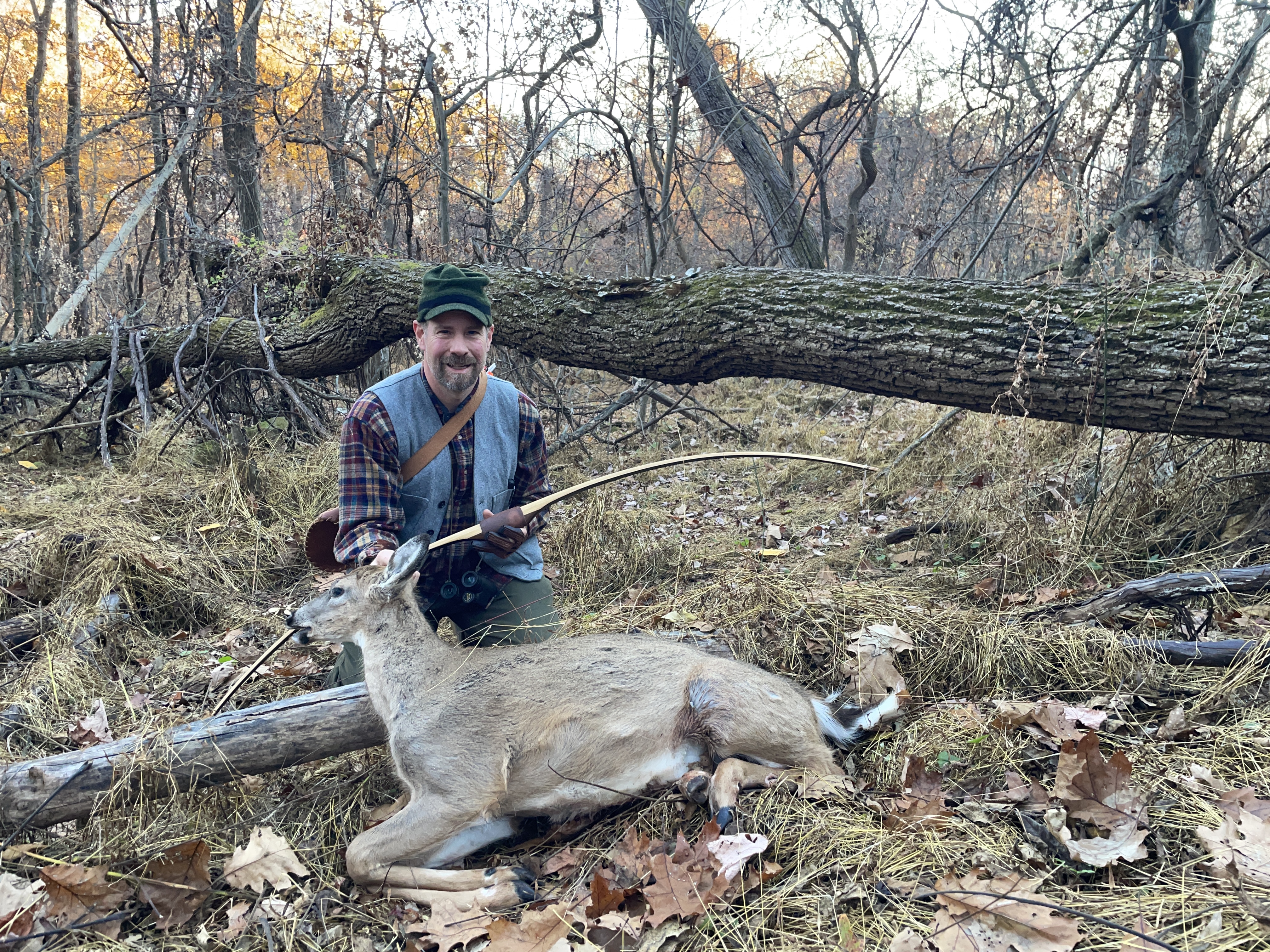
I recently had a chance to evaluate my past 16 years of traditional bowhunting.  During that time I'll killed 25 deer.  Half of those were from the ground vs a blind or treestand. Looking at only the last 5 years that percentage jumps to 63%.  My total success rate in the last 5 years is 32% greater than the total.  This tells me that I have learned a thing or two about sneaking around on deer as I have done it more.  

A recent week long deer camp trip to the big public lands of Allegheny county really exemplified how this can help a hunter.  There were 7 hunters in camp including one shooting a compound and one a crossbow.  After a morning sit at a pre-scouted location, I spent the rest of the week stillhunting.  I managed to spot a group of 3 deer and snuck up about 65 yards to arrow one.  If I had just sat there tethered to a tree they would have simply fed off and away.  Sure I may have blown the stalk, but it was an opportunity.  Sneaking within bow range of 3 sets of deer eyes and ears is a difficult task!  


Later that week I caught a distracted buck who was being harassed by 2 coyotes, and quickly working up to him sent an arrow through the ribs at 25 yards.  Again, if I was stuck to a tree or not moved from my seat, I would have likely gone home with just a story.  


There are several things that I have learned over the years that help.  Some folks talk about "walking like a deer", by making sounds like a deer walking instead of a human.  I have tried this but never with much success.  Almost always, I find it is best if the animals do not know you are there at all.

1.    Use your Binos

2.    Go slowly

The first bit of advice is to have a good pair of binoculars and keep them out and ready.  I like to sling mine with an oversized piece of parachute cord under the arm opposite my bow shoulder.  If you look carefully you can see them in the above two photos as it hangs about the level of the belt.  I stop and glass often.  Seeing the animal first is paramount to success. Scanning with the glass also helps you slow down.  Stand still/sit more than you move, and when you move, move slow as molasses in the wintertime.

3.  Play the wind

Hunt into, or across the wind.  When your stuck in the treestand and the wind changes it could really screw up your hunt.  Stillhunting you just need to adjust and continue.  I keep a piece of unwaxed dental floss tied to the top loop of my bowstring and can check the wind constantly that way with minimal movement. 


You can see the frayed ends of the unwaxed floss catch the wind easily in the above photo.

4. Bean Boots

Not any LL Bean Boots will do either.  The original Maine Hunting Shoe in my opinion is the best and closest thing to a modern Indian moccasin there is.  They run small and I wear them tight.  The smallest twig can be felt though the soft gum rubber bottom.  Not cracking those unseen twigs makes for a quiet sneak. They are slippery when wet, and some experience is needed on different terrain, but I have used them from desert to Mountains to swamp with success.  I carry insulated overshoes when it is real cold and still sneak around between sits in my beans.  Fred Bear used to use tennis shoes for the same reasons, but they get wet and soggy.

5. Don't wear loud clothes

I prefer wool.  Wool not only absorbs reflected light, it is super quiet.  There is nothing better in the woods.  When it is warm I like thin wool twill pants like what LL Bean used to call field pants.  Some like the newer wool camo like first-lite, but I don't like the baggy "freedom of movement" cut of those.  Some do.  I rarely us camo anymore and have not seen a decrease in success or encounters from wearing non-camo. Grey wool blends in great with winter hardwoods, and plaids break up the outline.  I still wear my old cotton military BDU pants, but even they are noisy compared to wool. 

6. Trails are quieter than breaking brush

Using deer trails and roads can be effective for moving quietly. Just be aware deer like to bed up in places where they can watch the trails and roads people are known to use.  Sometimes, they will be close, and will let you pass if they think you have not seen them.  If you see one like this, you need to make a shot while you are moving and acting causally.  If you stop and look at the deer it will bolt before you can draw.  I've never killed one this way, but I have had several opportunities like this.  One time, I was walking with a friend in front and I saw a deer watching.  I told my friend to keep walking and I stopped behind a tree.  The deer watched my friend and I was able to peak around the tree and get a shot as the deer was busy watching him (deer can't count). On my home property I take a leaf blower and blow a circuit to walk after the leaves have fallen.  Deer use these open trails too so you can actually create a runway past your ground blind if you want. 

7. Never step on, what you can step over

Timeless advice from Fred Bear.

8.  Sit when the deer are moving, move when the deer are bedded

You can sneak up on a bedded animal.  I have done it many times with elk and deer. I tend to sit still in the early morning and evening and sneak around in the afternoon.  Bedding areas are effective.  Sitting too long gets you stiff, cold, and is counterproductive.  Why not sneak around a bit and change locations after too long.  You may bump into something, and if you see it first game on!

 9. If you can sneak up in bow range of a squirrel you can do it with a deer.


Practice your sneaking skills on squirrels, no better practice for deer.  I tend to shoot one or two squirrels with my bow a year.  

To sum up, sneaking around the woods is a skill you get better at the more you practice.  Don't be afraid to try.  Don't be so rigid in your hunting.  Be flexible and it may payoff in the long run. Did I mention it is fun!


Friday, October 7, 2022

Deer Down - DIY Deer Meat Processing (Not Much Goes to Waste)

I was lucky enough to down this mature doe recently. I was reflecting about how much of this animal I was able to utilize as I took my time processing the meat myself.  Many folks do not want to deal with the time, hassle, and clean-up of processing your own deer meat.  However, I have found that it is well worth it for me.  I started out doing all of this in my townhouse garage with a fairly inexpensive big box store grinder and a few knives. 


Doing things yourself takes a little work, but I now enjoy it as the rewards are great.  I feel it is a honor to utilize every possible bit of the animal if I am lucky enough to get a fine deer with traditional equipment. 

The first Item I save comes from the dressing in the field.  I always have a ziplock in my pocket I can repurpose.   I take the heart and place it into this bag.  Some folks will also eat the liver, but I do not find that organ to be either tasty or palatable.  That is personal to me as I know too much Biology, Physiology, and Toxicology to enjoy that particular delicacy.  Some folks love fried deer liver and onions.

The heart is a muscle, so I enjoy saving and eating that particular bit that gets left in the woods by most hunters.  You can read up on an article I wrote just on this specific topic and my "victory Breakfast" recipe here:

Usually I'll be dragging the entire deer home to process, and hanging it by the gambrel. I usually come across the tail next while beginning to skin.

I have saved the tails of most of my animals for the future use of tying flies, poppers, and bucktail fishing lures.  I have dyed them many colors, and simply keep them preserved by salting heavily and allowing them to dry thoroughly.  I keep the tails in a big bucket with a snap lid.  It only takes a little time and care to fillet the skin off the tail and salt it down.  These tails are selling currently for around $13 each online.


Sometimes if I have the urge on a deer with a nice winter pelt, I will tan the hide with alum or ivory soap method.  It is a lot of work, but the hair on hides come out well.

Once skinned, I get to the lower legs and tease out the long tendons.  These are cleaned of meat and allowed to air dry until they are amber opaque.  Similarly, when I take the backstraps off and skin off the "silverskin", I will take scrape that back sinew off and allow it to also air dry flat.  The leg sinew fibers can be pounded out and used to make lashings and even bowstrings.  The back sinew can be added to the back of a selfbow to help it retain set and as a durable backing to prevent splinters from lifting.  Even if you don't use the stuff, which is great as it dries and shrinks as a super durable product, you can trade them to traditional guys that build their own bows.  Currently, leg sinew is going for $6 for four and back sinew is $9 a piece!  I throw them in a bin for barter later.

The backstraps get cut into chops, or medallions, to be grilled and topped with rosemary garlic butter or pounded flat into venison schnitzel recipes.


As I continue to process the deer I will collect the long bones.  I do not take a great deal of care while de-boning, which saves time, as the little bits of meat will help add flavor later to my bone broth.  I will also cut out the ribs to either roast whole or add to the bone broth stock pot.  I have seen bone broth sell in the organic stores for up to $10 a pint! 

You can read about my recipe for Bone both here:


While I am doing the meat cutting I will take the trimming waste and collect that in a bag for my sister.  She takes all the small meat and fat scraps and grinds it into cat food for her cat.  So that helps save bits that I would otherwise throw out.  I'm sure dogs would love these scraps as well. 

The other smaller trimmed pieces of meat go into another pile of burger grinding.  I will either course grind these into 1 pound bags for burger recipes, or I will can them in jars to free up room in my freezer.  Here is a typical easy burger recipe I wrote about:  I will often just grind into a large 2 1/2 gallon bag to make bologna, or summer sausage in the smoker at a later date.


The larger trimmed stew chunks go into another pile.  These I will almost always raw pack in caning jars for use in stew and soup recipes later.   


The 4 larger roasts from the back legs get placed in vacuum bags and frozen for later roasting, or for cutting up into delicious deer jerky my kid loves.

Likewise, the neck gets removed from the head and the shoulders and after the windpipe cut away, also gets vacuumed sealed and destined for the crock pot one cold winter day.


The front shoulders get de-boned into blade roasts and stew chunks, saving those long bones and scapula for the bone broth.  

I cut away the ribs with a cordless sawzall and either throw those in with the bone broth, or cook later as BBQ ribs.  Maybe one day I will write about that recipe, but I first boil them in coffee to render out the nasty fat that tastes chalky before roasting or smoking.  

I enjoy the process now of cutting up the meat especially with a friend over a cold beer or shot of bourbon.  I wrote about this process here:   When I am done most times the only thing that gets pitched in my back woods for the foxes are the lower leg and hooves, head, spinal column, pelvis and sometimes the hide.  I really like that I am able to utilize so much of the animal I work so hard to acquire.