Search This Blog

Monday, July 13, 2020

Susquehanna Snakehead Fish - How Do They Taste?

This spring the fish elevator had to be prematurely shut down at the Susquehanna dam due to the number of Asian invasive snakehead fish found getting by the dam.  I decided after hearing much talk about them expanding their range, to try and catch one and see for myself if they were really as tasty as I have heard.

My son and I drove an hour and 1/2 to Havre DeGrace, Maryland and met up with my brother Chris who lived near the river and had a boat.  He does much fishing in the river flats below the dam for striped bass and catfish, but has never seen a snakehead before.  He was skeptical I could catch one to say the least.  I told him they like shallow weed beds and tend to prefer buzz baits and top water splashing lures.  I set up my young son with a weedless frog and I put on a buzz bait.  We stopped at the second weed bed he knew about and I hooked and landed our first snakehead!


We fished the rest of the day but only landed a few bass.  I was excited to cook this one up!

I was shocked when I finally got home at 9pm and the fish which had been out of water and sealed in a contractor trash bag in the back on my vehicle for many hours was still alive!  These things are tough and I later learned they can survive up to 4 days outside of water.  That would explain the excessive slime. 

The fish was a bear to fillet.  It was bloody and the scales were like plastic plates.  I soaked the fillets in some salt water overnight and they were a nice pink color and meaty. 


The next day for lunch after rinsing in fresh water, I fried the fillets in butter with just a little lemon pepper seasoning to taste what the true flavor of the fish was. 


The moment of truth came and I am really impressed. 


The meat was a little more firm in consistency, but the closest thing I can compare it to was cod.  It was white and mild.  I believe this fish has ranked number 2 in my book just behind fresh caught trout.  My wife refused to try it because of the name, and I didn't push her too hard as there would be more for me.  My son and I both loved it.  I think I will start referring to this fish by its the new name of "Chesapeake Cod". It is definitely one of my favorites.

Monday, March 9, 2020

Trailing a Deer & Reading Sign

The Waiting is the Hardest Part

Originally published in Traditional Bowhunter Magazine online 1/2020 (tradbow.com)

https://tradbow.com/the-waiting-is-the-hardest-part/


The sun broke the horizon on this particular crisp early November day, and I sat there peacefully watching the yellow and red leaves periodically fluttering to the ground under the influences of a steady low breeze.

Then, I hear crunching behind my tree and I slowly turn my head over my right shoulder as I see a mature whitetail buck steadily trodding downhill.  Tall bright-white forked antler tines reminded me of a mule deer, and its large frame colored in more of a tan/grey hue gave this particular buck some unique attributes.

I calmed myself by some deep belly breathing as is kept on course that would carry it directly to a trail the stand was placed specifically to cover.  I was careful not to draw prematurely and expose myself to his peripheral vision, but as soon as he turned and stepped slightly downhill away from me I drew to anchor.  Looking at a spot of raised fur above where the front leg met the body, I watched as my orange fletch completely disappeared though the tan body a little back, perhaps about the last rib or two.

The buck instantly exploded away from the impact direction and crashed through multiflora rose and vines in a panicked escape.

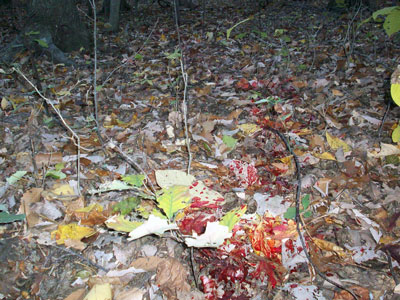
I knew the arrow was a little farther back than I would have liked, but convinced myself that his slightly quartering position caught at least one lung and probably the liver.   I glanced at my watch marking the time and sat reliving the action. I took a clementine from my cargo pocket and tried to relax as I passed the time with a snack.  After 45 minutes, I slowly eased out of the tree and crept over to the impact area.  I saw the scuffed hoof prints of his two front feet as he launched into his run.  There was no visible blood until I reached where he landed after his first jump.  There on the leaves, I found large blotches of dark red blood.  My arrow lay there sticking out of the leaf litter and covered in the same blood, broken just in front of where the fletch began.  Picking up the shaft dirt was only present on one side of the Ace Standard broadhead.

Continuing a snails pace, I saw blood sign on both sides as he ran.  A positive that two holes were leaking. However, after  about 45 more yards the faucet turned to a drip.  Then nothing.  Then blood again after about 5 more yards. I texted my friend and he suggested I give it some time. It was getting warm so I backed out and walked slowly and quietly back to my truck.  There I shed a layer, took a drink of cold coffee, and planned my next move.

I decided to still hunt my way back to the last blood in the overgrown hedges by a route through the main woods.  Later I would find this a major mistake as I ended up not far the last bed I found blood in.

Resuming the trail I eventually determined the direction of travel through some very thick hedgerow of multiflora rose.  Blood was specks now 10 yards or more apart.  I ended up having to literally crawl through a tunnel of vines to reach the last blood I found.  I surmised this was his bed, dark red blood stained two spots on either side, and no deer was to be found.  I searched the remainder of the day, the morning after, and a few hours on Monday.  Never finding the deer.

My brother, who has vast experience following wounded arrow struck deer, immediately confirmed upon seeing the photos, "Looks like a liver hit, they can last upwards of 2 hours with that kind of wound".


Initial good blood, but dark red indicating a liver hit.


The last blood and his bed.  In a tunnel of tangle he was watching his back trail.

This may be one of the hardest things to do after an arrow flies from the bow at a buck.  After many years of archery hunting deer, I am still humbled by my inexperience and the toughness of the quarry.  Learning lessons is part of the sport, but perhaps I can help others learn some of this an easier way by writing one of my most recent lessons.

My father taught me early on to wait at least 45 minutes before taking up the trail on a well hit animal.  He said, "an hour is better", but 45 minutes is the absolute minimum.  I still believe that is a good rule of thumb, but the caveat here is we are confident we have heart and/or both lungs hit.

Knowing where the animal is hit can go a long way to giving the hunter that first clue on how to proceed.  I prefer brightly colored  fletching and a fully painted white shaft or crest, others go a more modern route of lighted nocks.  Whichever method you prefer, seeing where a hit might be can help immensely after the shot.  Next look for clues where the impact area is.  Do you see hair?  Is it white or brown?  Look for the arrow or first blood sign.  What color is the blood, dark or bright? Does it have bubbles or foam?  Is it slimy or watery?  Does it have an odor? Are there food particles?  Take your time and examine it like a crime scene detective or scientist.  Look for the evidence and take time to consider it.  When in doubt, back out and wait.  If the evidence points to a gut shot, wait even longer.

Deer are tough customers and can survive and totally recover from a one lung hit, let alone not tip over an hour after being struck.

Table 1: Suggested minimum wait time before starting a trail

Blood Indication Minimum Wait Time
Pink and foamy Lung and/or heart 45 minutes
Thick dark red Liver 2 hours
Watery or slimy Paunch or gut 6 hours           

This buck was one lunged and kicked from its bed over 2 1/2 hours after the hit, where it made a final run before collapsing.  


Speaking of patience and reading sign, I am starting to believe this is one of the most overlooked aspects of the younger bowhunting generation.

One evening I was getting some coffee in a WAWA store when I noticed two obvious hunters clad from head to toe in the latest camouflage pattern.  I asked how they made out this evening.  The one spoke up and told me he shot a nice doe right at 6pm this evening with his compound, but it kept going and they never found it.  Now, it was only 8pm as we were chatting.  I was thinking to myself, how long did you wait after the shot before picking up the trail?  Trailing too soon, especially in the dark is a recipe for kicking the animal up and pushing it out of your range.  He should have just started trailing it at 8pm, and I'm betting chances would be better he would have found it.

Another bowhunter I know texted me he shot one of his biggest bucks to date at around 5pm one evening.  He said he was confident he struck the deer in the neck. By 5:24pm he was telling me the first blood was foamy.  Right away this told me windpipe, but did he strike the carotid or jugular? It has been my experience that with a neck shot deer it will either be down within 50 yards and a lot of blood on the ground, or it will be a long time if it ever succumbs.  At around 5:45pm he said the blood was now almost completely shut down and the animal was heading uphill.  I suggested he come back in the morning, but he continued to trail to no avail. When he finally gave up, he told me he found the buck bedded twice within 150 yards.  He just kept pushing it.


 This buck was given lots of time due to a neck shot, but he was found within 45 yards of the stand and didn't go far.

I should have learned the lesson several years ago on Maryland's Eastern shore hunting Sika deerI was fortunate to make a decent shot on a world class Sika stag at dusk on the last day of a grueling 3 day hunt.  I was way out into the marsh in the fading light as a monster Stag emerged from the brush and my first impression was that he has two Christmas trees growing at angles from his head!  I had already missed a few opportunities at smaller stags that weekend, and I doubled down on my focus as he walked 20 yards in front and broadside.  I saw the arrow strike at about the last, or second to last rib, but confident I got al least one lung.  The arrow was buried in the marsh on the other side.  Now, it was getting dark, a mile back in the marsh, I didn't have a good light or GPS.  I was impatient and wanted to use some of the last available light, so after 20 minutes I shimmied down out of the tree and took up the copious trail.  Just after where I last heard him splash there was a little hummock of dry ground and in it was a big pool of bubbly bright pink blood.  I got one lung, but obviously pushed it.  I was confident it would be lying just ahead, but an hour later and 1/4 mile into the marsh the trail crossed a ditch that had water over my waders.  I was forced to retreat in defeat. 

I still regret my impatience and feel confident that if I waited longer, I would have found him in that first bed. Next time I’ll be prepared!

When bowhunting I have come to realize the importance of waiting if the signs do not point you toward a quick recovery. As Tom Petty put it in song, “The waiting is the hardest part,” and so true in our modern fast-paced and immediate gratification society. Older and wiser, it may have finally sunk in.


Wednesday, October 30, 2019

Maryland Bear Hunting with the Longbow - 2019


This year found my small group of friends with 2 bear tags.  I drew my second tag after the 2015 season, and Brent drew his first.  My good friend Dan Breen from NJ had to cancel at the last minute, so I would be the only one hunting completely with traditional archery equipment. 

Some home maintenance problems kept me from hunting until Tuesday afternoon, when I made my way to the campsite in Allegheny County.  I had about 1 hour before the rains started:


Everything was set up except the awning and tie downs when the rains unloaded.  Thanks goodness I had enough dry wood and the wall tent woodstove quickly dried me out once I could relax.


That evening the rains let up and I decided to head out on the first hunt around camp. 

I immediately got into deer, and with my longbow in hand could shoot deer or bear. 
I was standing there enjoying the quietness and fall colors when I heard some grunting and scuffling noises on the hilltop above me.  I decided to try something that has never (ok, rarely) worked for me.  I grunted back softly. 

Immediately a doe came over the ridge and stared down at me from about 60 yards.  She was looking hard bobbing her head, stomping her feet, but I never moved.  After a few minutes she gave a half hearted blow and took 2 bounds to my right stopping again.

I still never moved.  Eventually, after still not getting any satisfaction determining what was down there, she started walking back to her left.  I took this opportunity to shift into a shooting position uphill should one present.
She continued, and eventually getting about 45 yards.  Now, i am getting prepared to take the first shot opportunity I have. 

Suddenly, she caught my scent and really blew out of there this time. Crashing and blowing hard 4 or 5 times as she went over the ridge and away.  Oh well.  Pretty close call. 


After, a while everyone arrived in camp.  We hunted a Wildlife Management Area (WMA) about 45 minutes away and I gt into my first good bear sign.  A ridge top covered in old and new poop, and complete with a bear den.  Lots of hickory and oak acorns.

I hunted that area for the next 2 days without any luck.

I even tried a little predator calling one morning downwind of the ridge. 

At camp we all enjoyed ourselves.  I had a nice pork shoulder roasted on my new fire iron set one evening.  Super good! 


I had about 3 more stalking opportunities at does, but no real good shot opportunities presented themselves.  A few arrows were also lost on squirrels. 
 
Soon we found the week over and no bears were even spotted by the entire camp.
I can say I did out out an honest effort.  No bait piles or blinds.  No guides or high fences. No gun hunting for me, and it didn't prevent any kills. Did a lot of bow shooting and had a good time with buds.   Maryland makes it hard on the bear hunter, especially the traditional archer.


Now back home to focus again on whitetails.

Friday, October 11, 2019

Ground Venison Recipe - Easy Helper


Ground venison burger is always the thing I tend to use up last from a successful deer hunting season, despite my propensity for making delicious venison bologna and sausages.

A co-worker told me about this simple and easy recipe and it has become a favorite of mine that will likely be a staple when I spend the week camping with the wall tent.


Ingredients:

2 cups of cooked jasmine rice (or noodles)
2 cups of beef or chicken broth
1 Lipton French onion soup mix packet
1 can of cream of mushroom soup
oil, butter, or bacon fat
salt and pepper

 In a large iron skillet brown the ground venison in a little bacon fat (or your choice of grease) until it is a little crispy.

Add the packet of Lipton soup mix, the 2 cups of broth, and the can of cream of mushroom soup.

Add salt and pepper to taste and let this simmer for 20 minutes or so, stirring occasionally..

Serve over the rice (or noodles) and enjoy a nice hearty and rich flavored meal.


Monday, October 7, 2019

Bowhunting Follies


Originally Published in April/May 2019 Traditional Bowhunter Magazine


I am fortunate enough to have a brother who is 10 years my senior.  Chris is an accomplished and seasoned traditional bowhunter of over 30 years’ experience.   Comically, he gives a whole new meaning to bowhunting “the Hard Way”.  Humorously, on every hunting trip it is inevitable that he will burn his boots or socks while trying to dry them by the campfire in the evenings.  His driving is so erratic and distracted, that it is a slight miracle that no serious car accident has resulted.  He is often speeding and braking on twisty mountain gravel roads while keeping one eye off to the side spotting game.  My sister goes so far as to nickname him, “Crash”.  

Chris still has not been able to figure out how to sharpen his broadheads with the file he insists on using.  No two arrows in his quiver are identical.   His wood arrows have differing lengths, spines, point weights, and varying degrees of straightness.  The fletching on his homemade arrows are often left-wing and glued on with a right-wing jig.  Chris sometimes uses his pen knife to crudely create his point tapers.  You can also forget about any attention to grain or nock orientation, and I make it a habit not to stand next to him while he shoots.  His arrows fly to their mark usually with varying degrees of angle, sidestepping, wobble, and noise.  Despite all this, he is an amazing bow shot and hunts with the tenacity of a pitbull.  He never seems to have much problem killing game. 
Chris has been set on fire, fallen, smashed himself in the face, gotten lost, and been on the receiving end of many disasters by his own hand while hunting.  He has a most impressive track record of “incidents”. He always survives, mostly due to amazing luck, yet he refuses to learn from most of his mistakes.  I am not sure how many of you have known a fellow like this, but I bet everyone has a similar story or two in their own past.  Chris’s experiences are unbridled entertainment around the campfire, and he always leaves the listener shaking their head in disbelief. 

Regardless of all this, he’s a great brother and hunting companion.  Sit back and listen to a few of my recollections about hunting with Chris over the years and across America.    Sadly, you just can’t make this stuff up!

The following story is typical for Chris, and variations have occurred on a few occasions.  One day, Chris was clearing away branches from a log crossing over a creek.   He was moving quickly and pushing a particularly sturdy dead branch away from him by the top to clear his path, when he failed to consider what would happen if the branch snapped higher than he anticipated.  The remaining wood sprang backwards toward him. CRACK!  He later recounted that a bright flash of light illuminated his vision as the broken portion of stick smashed open a gash directly above his right eye.  Miraculously, he did no permanent eye damage or get knocked unconscious into the freezing water.  


Another time, at the end of a day long elk hunt, Chris realized he was not in possession of his tube style side quiver and all his arrows.  It would soon be dark and It was too late to backtrack and look for them.  He returned the following morning to all the places he had stopped, until he miraculously found the camo package at one of his stops.  Good thing he did not see any elk until he had an arrow!
Exactly one year later, Chris returned to the same area in Idaho.  Yup, you guessed it.  He “felt light” and found he again had left his quiver at one of his stops.   At least this time he had one arrow on the string and could backtrack that day to find the rest.  Again Chris? 

Chris’s boorish and uncouth field habits are so suspect that most will not be eager to share a car ride, let alone a tent or sleeping quarters with him.  Midway through another week-long hunt while a companion was away from camp, Chris decided to use their collapsible drinking water bucket to rinse out his underwear.  His rationale was, “It’s okay because he used it inside out”.  The owner of course did not think it was such a good idea!  Very heated discourse ensued over the next several days around camp.

We were speeding down the freeway on a mid-hunt comfort break another time, when we were passed by a large pickup truck whose driver was emphatically motioning to his roof.  Suddenly, Chris realized that he had put his bow on the roof when he returned from hunting.  I will never know how the bow stayed on that roof rack at 70 miles per hour.  Typical for Chris it did.  Somehow, he always comes through in relatively good shape.  

On an arduous backcountry hunt in the Colorado wilderness, we found ourselves far from medical attention about 8 miles back on foot. Chris marveled at the large bright reddish-orange colored mushrooms everywhere, and decided he wanted to eat one.   His rationale was, “Well, the elk seem to be eating them and they’re fine.”  It was all I could do to persuade him not to do it.  He even threatened to eat one when I wasn’t looking.  I have no doubt without my emphatic protests he’d have eaten one.  Returning to civilization, I looked them up and identified the shrooms as Amanita Muscaria — toxic and hallucinogenic.  I can just picture him stumbling around the woods, talking to invisible creatures and shouting at the trees. Sheesh! 


Sadly, this was not the only example of my brother attempting to eat something he finds in the wilds without doing his homework.  We were seeing abundant prickly pear cactus with bright red fruit on our first New Mexico mule deer hunting trip together.  Chris heard “somewhere” that they were safe to eat.  The Javelina were sure tearing them up, so he gave them a try not exactly knowing the “how”.   The spines made his shooting hand fingers so swollen afterwards, He was unable to shoot his bow accurately for several days.  

Speaking of arduous hunts to the backcountry, like most greenhorn bivy hunters to the wilderness, he attempted to carry WAY too much weight for the 3-mile hike into our hunting area at elevation.  Chris started out with a pack weighing over 80 pounds.  Halfway up the 26 switch-backs, it was necessary to bury a portion of “extra gear” just off the trail.  Somehow, He did not learn his lesson.  Despite my repeated warnings to “go light”, the feat was exactly repeated during the next two subsequent years to the same location.   


In the fading evening light on a hunt in a Northern Idaho forest one year, Chris got turned around.  He started to panic when his GPS did not immediately connect with the requisite satellites.  Unable to see the display clearly as he misplaced his reading glasses, he started to trot quicker over two ridgelines he suspected was in the direction of camp.  Blindly crashing through timber, over deadfall, and through brush he exhaustedly crested the last ridge in a soaking sweat.  Communicating with me via his radio, he instructed me to honk the rental vehicle’s horn three times to see how close he was.  I proceeded to honk several times.  The radio crackled with, “go ahead and honk the horn anytime you’re ready”.   Sleeping that night only under his emergency poncho, Chris spent a cold miserable night.  At first light he realized that he was about 50 feet from an access road.   He stumbled back to camp around lunchtime and lost a fine morning of hunting.  


After that incident, Chris decided that he would rely totally on his compass for navigation.  He proceeded to use a power drill to inlay a small compass into the riser of his custom bow.  Not realizing the proper drill bit and speed to use for such an application, the resulting wood tear-out and cracked riser had him ordering a new custom bow.

Home adventures are also abundant, though I will stick with hunting related stories here.  Our hero lives on a corner lot along a historic small town main street with houses all around.  Discovering a groundhog had taken up residence under his shed, he decided to dispatch it quietly with his bow.  Hanging above the hole along the side of the shed was his prized fishing kayak.  Flinching badly at release, the broadhead passed completely through both walls of the kayak with impressive penetration from the hunter head and wood arrow.  DOH!!!!!!

One year in a certain wildlife management area, he was savagely ravaged by chigger bites which painfully covered his entire lower extremities.  Overly paranoid the following year, he diligently doused his entire form in highly concentrated DEET spray during preparations for an early season hunt.  Unfortunately, he slightly miscalculated his application to the face, and inadvertently sprayed a stream of bug juice into both eyes and mouth.  Twenty minutes later, swollen and hoarse from the extreme burning and intense pain, he blearily recounted the taste as, “Having a little kick to it.”
There was also the “legendary bowfishing incident”.   Chris had a particularly successful outing one evening and harvested several large carp.  He made the decision to fertilize the garden, and dug several holes burying the fish.  Two days later he was horrified to learn his Chesapeake Bay retriever had dug up all the rotting fish and rolled around on them.  To his wife’s chagrin, this was discovered after the dog was allowed back into the house where he rolled around on the soft clean carpet. 
Roving and stump shooting also offer grand adventure for Chris.  One day he was leaving the deer hunting woods when he saw his truck in the distance.   He decided to “see how close I could come to it from here”.  Well you guessed it, he center-punched a judo head into the hood of his pickup truck.  On another clear beautiful day, he spied a white piece of trash about 70 yards out in the middle of the trail.  Amazingly, his arrows arched beautifully through the air and pierced the object completely.  Walking up with smug satisfaction, he immediately realized his skewered trophy had been a freshly used, heavily soiled, wad of toilet paper! “Now how do I clean this off?”  

Chris has a unique and entertaining talent for getting himself into these situations.  I bet we can all find a little bit of Chris in us from time to time.  I’m genuinely thankful to have such a colorful and understanding brother, who not only allows me to learn from his mistakes, but also to record them in print to share in the laughs.  There is a “special” angel looking out for him… one with a sadistic sense of humor.


Wednesday, July 31, 2019

Packing Out a Deboned Deer from the Backcountry - Back Quiver Solution


I like to Hunt the backcountry with a back quiver, and a few of my hunting areas are in CWD  territory where you cannot transport the skeletal system and bones.   Packing out meat without a backpack, or having to make another trip to get a frame, pack, or cart was a literal pain.

Then I discovered the made in Idaho "Pack out Bags" on one of my elk hunts.  These slick Panniers for people, are lightweight, and can be packed into a cargo pocket or haversack. This leaves my back free to carry a back quiver until I kill something.  They are styled after the old newspaper delivery bags that allowed the paper-boy to carry so many rolled up newspapers on his route.


I immediately saw the possibility of packing out an entire deboned whitetail deer in one trip.  They say on their website, folks are astonished that they can usually carry twice the weight in the "pack out bags" that they could carry comfortably just on their backs.

The bags are super tough and allow you to evenly distribute the weight front and back, and the result is the ability to comfortably carry more weight over uneven or steep terrain. Made in America they are a quality item.  Hey, if it works on elk quarters, it should haul a Whitetail no problem.


Last year my brother killed a 100 pound doe in a CWD zone here in Maryland.  He was able to use the pack out bag system over his climbing Lone Wolf stand and took all of the edible meat out in one trip.  The system worked like a charm.


I carry lightweight T.A.G. Boned Out Meat Bags (BOMB) inside my belt pack, as they are also very light and small folded. The pack out bags attach with their integral strap when folded to my belt.  The folded bags are only 8 inches x 5 Inches x 3 inches.


Using the bags is pretty easy with a few tips.  Fill the meat bags evenly and hang them from a branch.

Then, you can don the "Pack out Bags" and cut the meat bags so they fall right into the front pocket.  No bending over.

Once full, twist the bag around so the empty back bag is now in the front.  Cut down the rest of the bags into the pack out bag.  Now you have an evenly distributed load, and I can carry my bow and quiver out.

Victory and smiles!


Friday, June 14, 2019

The Big-Five – The Elephant in the Room (Hill, Swinehart, and Negley)

Originally published as a Traditional Bowhunter Magazine Online feature:

https://tradbow.com/the-big-five-the-elephant-in-the-room/


There has been a controversy in bowhunting history circles since 1989 when Bill Negley published “Archer in Africa”.  Two questions were central to Negley’s claims in the book, and there was a chapter dedicated to each: “What about Howard Hill”, and “What about Bob Swinehart” respectively.  Who was the first to successfully Bowhunt the African Elephant under fair chase, and who was the first to successfully collect all of Africa’s Big Five?  Negley contends he was the first to do both, though convention until that time time was that Bob Swinehart was the first to take the Big Five, and Hill the first at the elephant.  The stories and historical record are muddied, vague, and complicated by rumor, jealousy, elapsed time, and the perspectives of the day.  Howard Hill was missing the rhinoceros in the chase for the Big Five, but nonetheless Howard is embroiled and central in this controversy because of the enormous African elephant.


Hill’s mission in Africa is quite clear.  He was financed to, first and foremost, film a profitable and entertaining major Hollywood motion picture called “Tembo”.   Secondarily, he wanted to kill some of Africa’s big game with his longbow to prove the effectiveness of the bow and arrow, as well as prove to himself he was capable of those accomplishments.  The problem was that movie making technology of the early 1950s made it very difficult to capture with any clarity these bowhunting action sequences on film.  The lighting was critical, the equipment heavy and cumbersome, and a film crew of several people were necessary to accompany him on a stalk and shot sequence.   This was a very difficult, if not impossible, task when trying to get all the action on film with dangerous game at bowhunting distances.  Imagine stalking up on a lion or cantankerous rhino with three camera guys outfitted with tall whirling camera gear, a professional hunter with backup rifle, and a couple trackers. 

Hill therefore may have done what he needed to do to get animals on film, and this is where later critics like Bill Negley take exception.  It was suggested to Negley by Bob Carpenter, that Hill had his professional hunter knee cap the elephant to get the close-in bow shooting and action shots on film.  This was supposedly proclaimed to Mr. Carpenter by some of Hill’s camera crew and assistant hunter when he was camped a few miles away from Hill’s camp during the filming.  The story was that the group traveled daily to Carpenter’s camp after sundown for some cocktails because Hill was a teetotaler (not a drinker) and had a dry camp.  Hill’s own written words and collaborating stories since prove that this basic premise was not the case.  Mr. Hill enjoyed his drink as much as anyone, and even overindulged at times in his life.  

In any event, it was clear that the Tembo elephant was in question as a fair chase kill, and other animals such as the lion and leopard in the film Tembo can clearly be seen to be “restrained” or snared to get the requisite action shots for the feature film.  Leopards are nocturnal and this was likely the only way to get a leopard shot on film in daylight in those days.  Unfortunately, these methods to get action shots on film for show business are extrapolated to all of Hill’s game in Africa.  What is left out of his detractor’s accounts though, is the fact that Mr. Hill spent many months in Africa, and shot several other animals off camera.  He shot two other elephants with the bow, not on film, and which he would have had no reason to take liberties with rifle or snare.  There has never been any film footage of the other 2 elephants, and it should be assumed they were not “handicapped” before being arrowed.  Remember, Hill was also interested to prove the effectiveness of the bow.   In Wild Adventure Hill recounts his unsuccessful shot at a bull elephant.  A small branch deflected the arrow and it ended up striking the jaw, embedding in a tooth.  The pachyderm ran a few hundred yards, shook off the initial shock of surprise and removed the arrow.  Then it ran back to search vengefully for the source of his discomfort.  “For a full two minutes, the maddened elephant ran first in one direction, then in the other, trying to locate us.   We could have killed him half a dozen times with the heavy rifles, but knowing that he had received a very slight wound from the arrow, we did not want to shoot him with the rifles unless forced to do so in order to save our own hides.”  This elephant was clearly not kneecapped before being shot with the arrow.  


 Shown here is a rare photo of one of Howard's "other" elephants.
 
Hill was never able to get a Rhinoceros with his bow.  When it came time to hunt the rhino, he had broken his bow hand and was not able to pull his heavy bow.  He did not want to risk a shot with a lower weight bow on such a giant animal.  Therefore, Hill was not in contention, nor ever claimed to have achieved completion of the Big-Five.

Negley traveled to Africa in 1957 and did kill an elephant with his bow, but it was not until after Hill’s death that he contended that he was the first to successfully do so under fair chase.  It seems he carefully avoided speaking to Mr. Hill, or challenging the validity of being the first, until after Hill’s death. 

Nine years later in 1966, Bill Negley heard that Bob Swinehart had announced that he was on a mission to kill the Big-Five with his longbow and was getting a lot of good press.  Bill was envious no one was talking about his accomplishments, and he decided to come out of dormancy with the bow and arrow and try to beat Swinehart to the punch.  After all, he had already collected the elephant in 1957.  The race was on!  

Unknown to Negley, Swinehart managed to complete the Big-Five by killing a lion prior to Negley even leaving for his safari in 1966.  When Negley returned from the bush after completing what he thought was the winning kill, he learned of Swinehart’s success and conceded publicly that Bob was first.  

After Bob’s death in 1989, Negley was meeting with a group while planning another African safari, when one of the men at the meeting who was an assistant professional hunter in camp on Swinehart’s  Elephant hunt, but not actually witness to the events, told Bill that the gossip around the camp.  The word was that Swinehart also first anchored the elephant in the knee with a rifle before shooting it with the bow.   Negley contended that is how Bob was able to get so close, get three arrows in the bull, and get some of the pictures of the event published in “Sagittarius” and ‘in Africa”.   Negley then published his book “Archer in Africa” claiming that he was the first to kill the big-Five under fair chase, and that he accomplished it largely without rifle backup.  All of this was based on second hand hearsay, in contrast to what Bob wrote in his publications, and without Swinehart being able to defend himself from the claims. In addition, Bill fails to recognize that Swinehart also bow killed a second elephant in Angola.  Swinehart recounted that he wanted to prove that one arrow alone could be responsible for the demise of such an enormous beast.  This he accomplished on this second bull. 
Bob went out of his way to explain that his first rhinoceros was not a valid bow kill because it charged after his arrow struck a fatal shot, and had to be put down by rifle fire.  He was published as stating, “Any bullet striking the animal would have destroyed my chance for a bow kill.”  He had to travel back to Africa on subsequent safari to get his rhino.  This does not sound like someone who would take liberties with kneecapping an elephant to me.  


 Knee Capped?  I don't see it?

 
Despite all these tales and controversies, each man; Hill, Negley, and Swinehart have their place in the Bow hunting Hall of Fame.  Hill’s legacy is well documented with a list of accomplishments that will never be rivaled.  Negley went on to bowhunt many species and examples of Africa’s dangerous big game largely without rifle backup.  Swinehart, whose life was tragically cut short, still managed to follow in his mentor’s footsteps by igniting bowhunting dreams through shooting exhibitions, presenting talks and slideshows at events, and publishing two cherished bowhunting books that are still regarded as must-read classics for those that can acquire them.  Each has earned their place in history, interconnected by the mighty African elephant.