Search This Blog

Thursday, February 22, 2024

Hunting the Hard Way - Why do it?


A reported 13.7 million Americans hunt some form of wildlife.  About half of that number bowhunt.  Only 2.6 million use traditional gear.  From my own observations at gatherings only about 5% of the traditional community uses the American Semi-Longbow or Hill style bow.  I think it would be generous to say 50% of that number were shooting a back quiver.  Probably, less than 50% of those use one to hunt with.  Crunching those numbers, I am only one of several thousand hunters in the country who chooses to hunt with the equipment I do.  Throw in my propensity to hunt from the ground and shy away from camouflage and the numbers get really small.  So, as far as hunters go, I am truly an odd duck, or the “few elite” as I like to see it. Interestingly enough, just 65 years ago, I would be among the majority of archery hunters on the cutting edge of technology.  

              So, one could ask, Why do it?  Why take the hard way?  Why spend hours and hours practicing my shooting, sharpening my stalking skills, researching plants and trees that game prefers, travel great distances to partake in unguided hunts, practice my calls on my way into work each day… and through all of this, usually come home empty handed. Why, when you could make things much easier?

              The answer is something inside of me.  

              There is a feeling and satisfaction that only the longbow hunter knows.  A point when you stop directly interacting with the woods, and you become a part of the woods.  Like an out of body experience, you are there, but you are not.  You see the animals in their natural state away from the human eye.  This feeling triggers primal endorphins that leave some, like myself, hooked and starving for more. 

              As my personal journey continued, this feeling wasn’t enough from 25 feet high in a tree.  I wanted to be closer, more in touch.  I wanted things more on my terms.  The gadgets and crutches pedaled by the outdoor industry became less desirable.  I wanted to be successful using my skills and knowledge.  Quickly, I figured out that I didn’t need a backpack full of gear to kill a whitetail.  In fact, some of that stuff made it harder!  I tried more and more hunting from the ground, and I became better and better at getting opportunities that way.  I started trying to stalk game I saw instead of waiting for them to “come into my shooting lane”.  My gear changed as well.  Simplicity became the appealing virtue.  My bow evolved into a simple long elegant and delicate bamboo laminated longbow.  Suddenly I didn’t have to wait for that deer to stop in my shooting lane.  I could hit things that were moving.  Wow was this getting fun! 

              Now I sit down in my basement workshop and look up at various “trophies” hanging on the wall and notice the lack of huge mule deer and elk antlers, no P&W sized antlers, nothing that most modern hunters would say were “impressive”.  That is if they don’t consider any of the how.  The struggles, the effort, the missed opportunities, the ones just out of range, and the misses.  All this makes up for it all in the long run.  Each one is something special in the journey.  I would not trade any of it. 


Wednesday, January 31, 2024

Benefits of a Higher Draw Weight Longbow for Hunting

Taking a sample of data found in my collection of vintage Traditional Bowhunter Magazine Harvest gallery write ups, I was able to compile approximately 130 listings where bow draw weight was recorded.  The resulting table below of average draw weights from successful hunters demonstrates how hunting draw weights have reduced from the 1990's


In the 1980's the majority of hunters shot more than 55 pounds of draw weight for hunting. It is a rarity to find a Hill style longbow made by folks like John Schulz, Louie Armbruster, Pete George even in the 50 pound range.  Most bows you find are in the 65-85 pound range.  While learning good form it is important for beginners to have a comfortable lower draw weight, however once you learn to shoot consistently there are many benefits to hunting with a little more "umph".  The current low poundage trend has swung the draw weight averages far to the other end of the spectrum.  While it is true that modern high performance archery gear is a little more efficient now than some of these older bows, I still believe in then the old adage of,  "for hunting shoot the highest draw weight you can comfortably pull".  I will attempt to explain that a little, and communicate what value I have found in going "against the grain" and working into a higher draw weight. 

Choosing a draw weight that is "comfortable" for the individual is the key.   No one range or optimal weight can be determined for all hunters. Differences in health, age, strength, injury history, general physical ability all play a factor. Since higher draw weight is subjective, and has changed throughout the preceding years, for the purposes of this article I will define it as draw weight at, and above, 55 pounds at your draw length.

The first consideration is to look at your ultimate goals.  If you wish to shoot a 300 round, or run a couple 3D courses in a day, or be able to shoot 30-50 arrows at a session, a higher draw weight bow may not make sense.  However, if you are a hunter choosing a heavier draw weight has some very real advantages in the field.

Many folks will immediately fire back with the argument, why should I hunt with higher weights if the lower poundage will still kill most North American game efficiently?  While it is true bull moose have been killed successfully with bows, especially more modern and efficient designs with heavy front loaded EFOC arrows, I propose that you may desire some of the other benefits that higher poundages offer.

First and foremost is Kinetic Energy (KE) and penetration.  Nothing adds to ease of blood trailing than 2 holes from which to leak.  Getting a pass through when the shot is perfect and only through the rib cage can be done easily with sub 45 pound bows, but what happens when our shot is not perfect and bone is hit.  I prefer being able to punch through the offside leg if possible and get that other hole leaking outside the cavity.  How about punching through the spine?  The energy that is retained in the arrow is directly proportional to the speed and mass of the arrow.  If you play around with the spine calculators enough you will soon realize how much increasing your draw weight adds to the KE equation without loading your arrow weight and adversely affecting trajectory.

Speaking of arrow trajectory, that is the next big benefit to increased draw weight.  While it is true most hunting shots are under 20 couple yards, being able to shoot flatter can transmit to more opportunities if you put in the practice work to be proficient at those ranges. A flat shooting trajectory just helps make that shot more accurate which is why target archers typically use very light arrows.  I recently shot a buck that was much farther than I usually shoot.  I didn't realize the distance but only that I was confident I could hit it.  I made a darn good shot and he was down in seconds, but when I paced it off later it was 38 steps uphill back to my tree!  If I had been shooting my old 48 pound bow the shot would have probably been too low.  To boot, my arrow went completely through both front shoulders and made two holes.


* This deer was shot with a 62# longbow at a range of 38 steps and I had two holes through both shoulders with a H. Hill head.

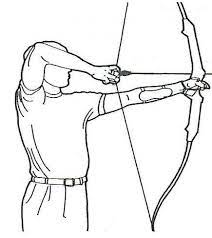
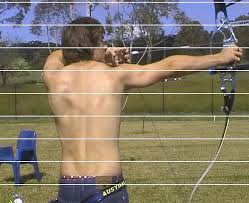
When I was working up in draw weight I was careful to continue my good form, or what I thought was good form.   I learned quickly that heavy weights call for a lower draw.  It is easier for you to pull a heavy weight down near your chest, rather than up near your ears.  I realized my form wasn't as good or as strong as it needed to be.  I was "muscling " the lower poundages and that fact was hidden by a lower weight.  The heavy practice allowed me to listen and correct my drawing alignment issues and use more back tension.  Bonus!  The heavy weights do not cure a lot of ills with your shooting, but they do improve success if you are shooting them with good form and not flinging haphazardly.  There are many older gentlemen I know that are over 60 and 70 years old and still shoot very heavy draw weights.  I think that some of this success and avoidance of injury is due to the swing draw as taught by Hill and Schulz.  This draw starts low where shoulder position leads to increased leverage.  The popular target style of  the set straight arm target style places the arm and shoulder in a compromised position for the weight.  When you look at doing rows at the gym, your arms are low at chest height to get that power.  If you lean forward and lower your head, keep that bow arm with a slight bend and the draw lower, I believe this will allow an easier heavy draw without the risk of injury.  Just keep in mind that shooting a heavy bow is not something you work into overnight.  You need to incorporate stretching and slow progress upwards.  Make certain you are in control at all times and come to full draw.  I cut my broadheads and judo points so the back of the head is against my finger as a draw check while building up (and actually for hunting as well).  This is a built in draw check and clicker.  

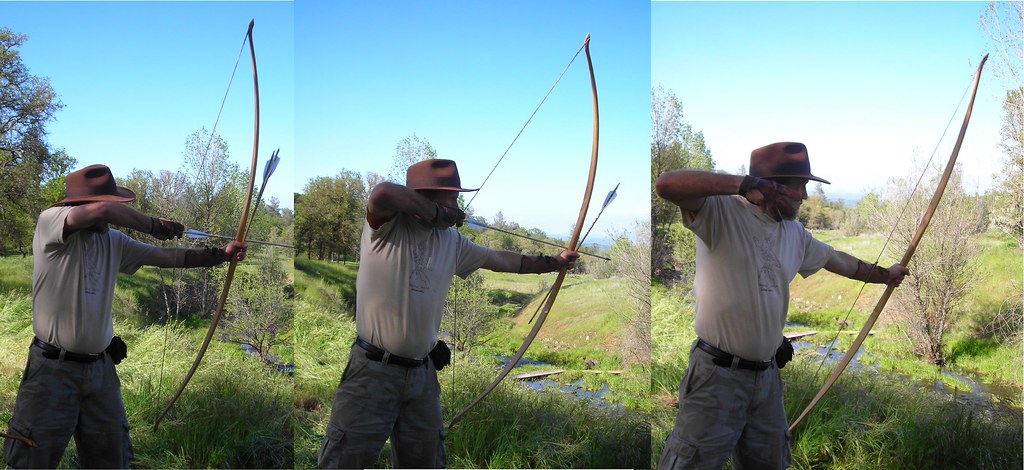
* Hill demonstrating the Swing Draw, note how low the elbow is when the weight starts to build.

 Note in the series of photos above that the string elbow is far to the rear when the bow weight starts to build.  Is it easier to pull heavy weights up by your ears, or down low to your chest?  If one starts pulling with the bow arm extended that string elbow is far forward and much weight is introduced when the shoulder is at its least mechanical advantage.  I propose to draw low and safely, and bring that bow and string up to anchor.

David Dewey's (aka Woodbear) Bows - PaleoPlanetSTEP 4 BOW HAND, BOW ARM and PREDRAW STEP 4 BOW HAND, BOW ARM and PREDRAWKSL International Archery

Note the high elbow and poor shoulder position for pulling heavier weight in this classic target stiff arm high draw.  Try this with a heavier weight and it will be more difficult and you will be more prone to shoulder injury.  

Heavier bows also assist with the cleanliness of the loose.  The heft pushes those fingers out of the way with less chance of string deflection issues.  This help could pay dividends with stressed shooting at game and with those unorthodox shot positions that the Hill style longbow also makes easier.  All this leads to better chance of hitting game in the woods. As long as your not suffering from Target Panic (TP) and let me broach that issue next.  

It is commonly known that lowering draw weight may help one address TP issues.  I do not disagree, however I will propose that lowering draw weight is not a "fix all" for TP either.  Eventually even the lower weights will display TP issues if the shot is not corrected.  The real fix is your shot process, the weight you pull is not the determining factor for beating TP.  I will propose that the problem is between the ears, not between the shoulders.  If you start to have issues with TP, lower your weight and fix your shot first.  Draw and hold with your back muscles only.  Then, move back up in weight to hunt.  You can just as easily get TP at 45, 40, or even 35 pounds.  To me the biggest thing is using the correct back tension and low draw to hold that weight properly.

 In short, shooting a heavier draw weight taught me better mechanics, the swing draw was the guide.   Hill shot 60 plus pounds toward the end of his life as did Fred Bear, why can't most handle those weights now? Maybe we should stop promoting the lowest poundage we can, and follow the old advice of the heaviest draw weight for hunting we can handle. 

Friday, November 17, 2023

2023 Eastern Shore Maryland AFI Duck Camp


I was fortunate enough to have been chosen one of the four veterans to participate in this unique opportunity.  It had been many years since I last hunted ducks, and being a motivated DIY'er I had never been on a guided hunt before.  

I can't say enough about the great experiences I had with Wingman Guide Service.  Joshua Bourne runs a fantastic operation, and it is evident his service is a passion, not just a business for him.  

I arrived to a wonderfully furnished house and made to feel welcome by a truly family run operation.  I was provided with a snack of bacon wrapped marinated jalapeno duck poppers as we enjoyed lively conversation around the blazing fire pit.  After a hearty feast of mashed taters and pot roast for dinner, all the prior service vets discussed our "war stories" probably a little later than we should have stayed awake.


At 0300 Joshua was up early whipping up a fine breakfast complete with potatoes, eggs, toast, sausage, and hot coffee.  We were ready to hit the water by 0500 well fed and excited for the adventure.

The weather this day was challenging, but our capable guides knew an area where they had not pressured birds and their knowledge of the vast marshes proved invaluable.  After the 30-minute boat ride we started to put out our set just at first grey light.  Soon we were nestled in our little floating island between two decoy sets and ready to watch the skies.

Lack of wind and clear conditions made it challenging to predict the travel and direction birds would come in, as they pretty much had any angle they wanted.  


Soon we were rewarded with birds and had several good opportunities in these really bright and clear conditions.  My shotgun wing shooting was a little rusty at first, but I was finally rewarded with a lone bufflehead that came streaking in over my direction just over the water and swinging from left to right was I fold it with a single blast as the others watched.  That one did feel good!

We ended the morning with six birds along with a interesting bluebill duck in the mix.  


Getting six birds in tough "fowl" conditions was pretty successful!

I had to bid all adieu fairly early to pick up my son from school, but I thanked Joshua and his son for such a super time and great guide skills.  Said goodbye to my new veteran brothers from the hunt.  This BHA AFI program and the generous donation by Wingman Guide Service was a great experience. I highly recommend and thank all involved!  


Wednesday, November 8, 2023

2023 Traditional Maryland Puiblic Land Deer Camp


Well another year in the books for the annual western MD trad deer camp.  Only 3 traditional shooters this year due to a variety of reasons including illness etc. 
 
As usual it was a hard hunt in the hungry public woods, but the group managed to again draw blood when my brother Chris shot this little 8 point and we had the meat pole in use again. 


Cold weather had them moving.
 
I passed up a 2 inch spike who ran a doe and fawn within 10 yards of me on the first day and lots of small bucks chasing out of range the rest of the hunt.


Dan brought some Polish beer from New Jersey and we ate well.  Roasted a leg of lamb on the fire one afternoon.
 
Was a good time despite the low turnout.


Monday, October 30, 2023

Another Try for Longbow Bear in MD - Almost!


After 5 years of hunting the one week, no scent no bait, MD bear season in the past without a single sighting even...I got a good shot at one and a lucky bear was educated.  


The Terrain was a steep Mountain area that has a fire trail running parallel to the ridge line about halfway up.  There is an old abandoned farm and orchard downhill from the fire road and steep hardwoods above.

3 of us went in the fire road at first light.  Walt went uphill first and set up along the ridge.  Brent and I kept going until we reached the access to the farm.  I went uphill and set up in this bench area.  Just walked in and straddled a blow down near the root ball.  No cell service at camp but signal up on the mountain so I checked my phone, and of course that is when I heard a branch snap.  Brent had gone down the fire road that turned around a bend from where I went up and was still hunting.  He must have pushed the bear, but he never saw it.  


I heard something running about 60 yards out and tried immediately to see if it was "brown or black".  It was black! The good-sized bear looked like it was going to pass above me at about 35 yards on a good trotting gallop pace and I had a window.  I thought this maybe my only chance at a shot so as he past a lane I actually pulled back to ¼ draw, but then let down.  This is when it took a right and started coming down!  I went from afraid it would never get close...to Oh my gosh it is going to run me over in a second!  It was still quartering towards me and about to go parallel at only 10 or 12 yards when I drew and picked a spot behind the front leg and the arrow was on the way.  I heard a crack and watched in horror as the bear looked towards me and I watched 2 halves of my arrow fly just over the bears back! I said "SH*T" out loud as I reached back and got another arrow on the string.  The bear had meanwhile taken to or 3 fast bounds and stopped about 25 yards away quartering hard away and looking back at me.  I was flustered by this point and I wanted to try another shot fast and forgot to pick a spot in all the excitement.  This was the shot I want back!  I aimed at the entire bear and watched my arrow go up over it's rear end and thunk into a tree.  I watched the rumpling rear kick up leaves as it careened downhill out of sight towards the thick hedgerows of the farm below the fire road.  

My view of the first shot. 


Wow, you don't know excitement until you are at full draw on a predator that close on the ground!  WOW~!

The results of the first shot. You can see the business end of my arrow stuck in that log behind the fletching end.


After I dug my second arrow out of the tree (having a pinned head really helps get them out of a tree without the glue line breaking).  A doe actually came up and snorted at me from the tapping of my chisel tipped file to dig out the Hill head...I guess she thought I was a woodpecker and got in close to investigate. I tried to head way down the valley and head off the bear but never got to see it again.

I am pretty sure I caught a glimpse of another bear on the last evening hunt but again I could not get ahead of the animal i spotted way ahead in a valley.

Now I am excited to get back in 2 days for deer camp!