Originally published in Traditional Bowhunter Magazine web content located here:
The
small skiff motored ahead through an increasingly stiffening headwind
as the archers strained to see through the choppy surface and murky
depths. Suddenly, one of the bowmen shouted “RAY” and pointed starboard
with his arrow. Almost drawing simultaneously as the skiff turned
sharply toward the ray, two arrows cut the water just as a form the
width of the skiff itself jettisoned ahead. How did we miss?! This was
harder than it looked…
I
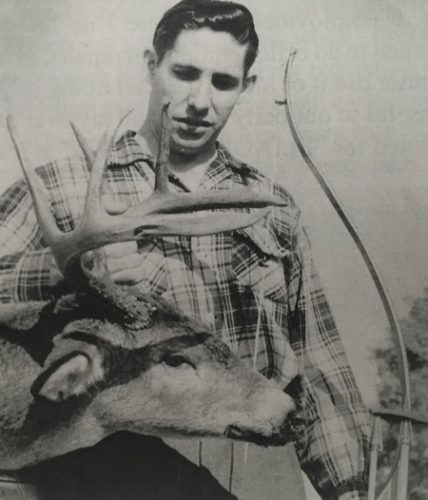
was fortunate enough to befriend and learn the basics of stingray
hunting from the late legendary bowfishing pioneer, and Maryland
bowhunting legend, J. Rob Davis. Mr. Davis passed away in June of 2013,
but his legacy is vast. He committed his life to promoting bowhunting,
and especially to introducing new bowfisherman to the sport of stingray
hunting. In 1952, Rob was instrumental in helping to lobby lawmakers to
create the first bowhunting season in Maryland. During that short
one-week season, Rob accounted for one of the first few deer taken in
Maryland with the bow and arrow. His second deer took seven more years
to collect, but that buck would turn out to be the first Maryland Pope
and Young record book deer.
Over those years, bowfishing and
mentoring others in this new sport became a passion for Rob that was
fueled by the proximity of bays and coastal waterways around his home.
He began to produce his own archery tackle, including constructing a
small boat to help him pursue his quarry. Soon Rob became skilled at
collecting carp and other rough fish, so he decided to turn his
attention towards stingrays, and eventually even sharks. He collected
his first ray in 1958. His largest ray weighed in at 133 pounds, but he
often guided the boat while others shot larger specimens over 145
pounds. Some of the sharks he hunted or helped others shoot were over 8
feet long and over 200 pounds! Several hundred of his pupils from all
around the country were tutored by this experienced instructor over the
decades, and he penned over 100 articles for bowhunting publications. I
was lucky enough to be among one of the last groups he was able to
introduce to the sport.
At the time of our trip in 2012, described
at the beginning of this story, Mr. Davis had over 60 years of
bowfishing experience under his belt. In addition, the first mate on our
trip was Rob’s son, adding another well-seasoned instructor to our
experience. I will attempt to describe the techniques and equipment
taught to us during this hunt.
First,
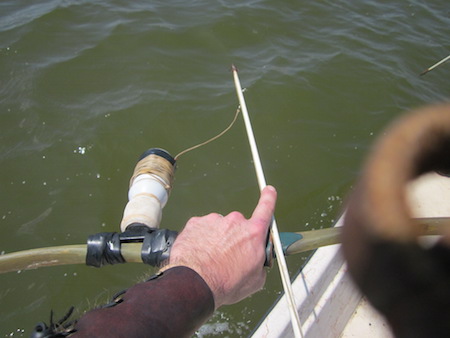
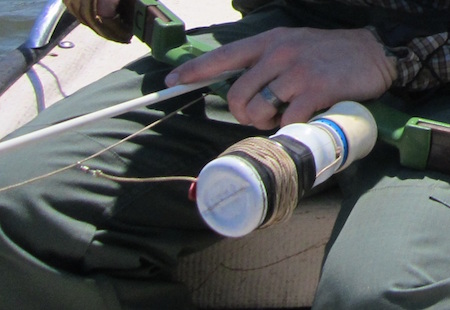
of all let’s discuss equipment. On our hunt with Mr. Davis, I used a
strap-on accessory bushing upon which I had screwed the rubber crutch
tip to accept a plastic bottle. Mr. Davis already had rigs that
consisted of; a crutch end cap, a small sports drink bottle filled with
expansion foam, a 2 inch strip of rubber bicycle inner tube stretched
over the bottle, a plastic clip that was nothing more than a piece of
coffee can plastic secured with glue under the inner tube making a tab,
and about 20 feet of 400# test braided line attached to a heavy duty
swivel. The swivel served as a slide threaded through a cabled
fiberglass fish arrow.
Line is connected to, and wound around, the
bottle allowing the shooter to fire line directly from the bottle,
which is then pulled off the crutch tip and acts as a float as the ray
departs. The float can be retrieved and line wound around the bottle
like a reel until the ray is close enough to the boat/surface for a
second arrow to be shot into it, if necessary on a larger ray.
One
of the most vital pieces of equipment in this type of hunt is a good
pair of polarized sunglasses. Mr. Davis was of the opinion that brown
tinted lenses were superior in locating rays. Polarized glasses cut down
tremendously on the surface glare and give the bowman a chance to spot
the rays before they scoot away.
This technique demands teamwork
and fluid communication with the helmsman of the vessel. The shooters
stand at the bow of the boat, while the helmsman steers at a slow troll
until a ray is spotted by the shooters. The shooters point in the
direction of the ray with the arrow so that the helmsman can steer to
within 10 or 15 feet of the ray for a shot. Because of the water
refraction, the point of aim should be at the bottom edge of the ray to
stick it, otherwise a miss high will result. The deeper and farther away
the ray, the smaller and greater the angle of refraction, which
increases the difficulty.
Once a ray has been hit, never handle
the line alone without the protection of a leather glove! The bigger
rays may take three arrows to get up to the boat and gaffed. After
gaffing, the ray should be pulled up so it’s tail is in the water but
it’s head can be hit with a cudgel (mallet with a 1 inch screw
protruding from the face works well) and struck between the eyes a few
inches back.

Once
the cudgel has been applied, heave the ray on board the boat and
immediately cut the tail muscles on each side (Mr. Davis uses a
machete). Then the barb can be cut away and placed inside of a soda
bottle with a 50% bleach solution. Kept in this solution overnight, and
then rinsed with cold water, the venomous grey mucus will be dissolved,
leaving a bright white memento of your hunt.
We only had that one
fleeting chance at one of the bigger Southern rays on our 2012 hunt, but
we did get plenty of shooting at the smaller cow-nosed rays. The
bowmen’s inexperience, combined with difficult weather conditions that
day, left us with loads of fun and a hunger to return some day and
accomplish the mission. Regretfully, it will be without our mentor.
Perhaps this writing may help to share his knowledge and continue the
legacy of introducing more folks to this challenging and rewarding
sport.
If you are lucky enough to catch a ray or two, below are some of Mr. Davis’s preferred cooking methods:
Cooking and Preparation:
First
remove the skin of the “wings” before the underlying fillets are
removed, otherwise removing the skin is difficult. Make sure ALL
cartilage and the white membrane that separates the muscle from the
internal organs are removed, otherwise the fillets will have an ammonia
odor and taste. Both the top and bottom of the wings can be filleted in
this manner.
Cut the skinned meat into 2-inch strips and marinade
overnight in equal parts of cooking oil, concentrated frozen lemonade
mix, and light soy sauce. Mr. Davis preferred to grill over coals, but
oven broiling for fifteen minutes per side was another favored method.
Others have commented favorably on the use of commercial marinades as
well.
Cutting rays into 1-inch chunks and dipping into a milk/egg
mixture before coating in Italian breadcrumbs and deep frying is also
very tasty. Ray also works well if parboiled to an opaque consistency
and added to casseroles, crab cake, or any other “crab” recipe.